

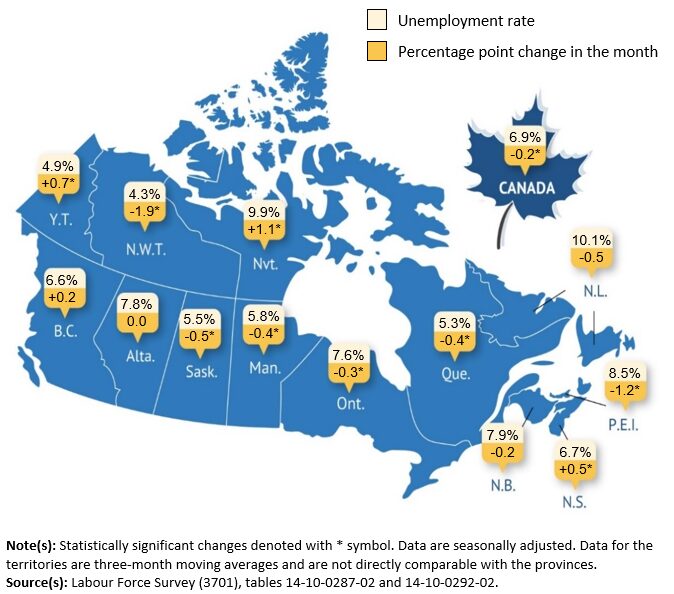
Canada’s job market is showing signs of resilience, with the country gaining 67,000 new jobs in October, defying forecasters and building on September’s gain. The unemployment rate also fell two-tenths to 6.9%, back to its level in July.
The private sector drove the increase, adding 73,000 jobs, although positions were mainly part-time, with 85,000 part-time jobs added.
Wholesale and retail trade, transportation and warehousing, and information, culture and recreation were among the sectors that saw job gains, adding 41,000, 30,000, and 25,000 jobs, respectively. However, construction saw a loss of 15,000 jobs.
Sectoral Breakdown
- Wholesale and Retail Trade: 41,000 new jobs
- Transportation and Warehousing: 30,000 new jobs
- Information, Culture and Recreation: 25,000 new jobs
- Construction: -15,000 jobs
Wage growth also picked up in October, with average hourly wages for employees up 3.5% versus a year ago, compared to a 3.3% pace in September.
Key Implications
The solid back-to-back job growth in September and October suggests that Canada’s labour market is proving more resilient to trade tensions than expected.
However, the labour market has still softened through 2025 along a number of dimensions, with the unemployment rate rising and wage pressures cooling relative to a year ago.
The Bank of Canada is likely to take a cautious approach, letting the 275 basis points of rate cuts in this cycle work their way through the economy. While the report shows some resilience in Canada’s labour market, overall job market conditions remain soft.
Regional Insights
Ontario led the way, adding 55,000 jobs, while Newfoundland and Labrador saw a smaller rebound, adding 4,400 jobs. Nova Scotia lost 4,400 jobs, pushing its unemployment rate up to 6.7%.
Economic Outlook
The labour market’s sturdy performance is crucial as Canada navigates potential trade tariffs, slowing population growth, and an upcoming federal election. While challenges remain, the gains show that parts of the economy are still creating opportunities.